
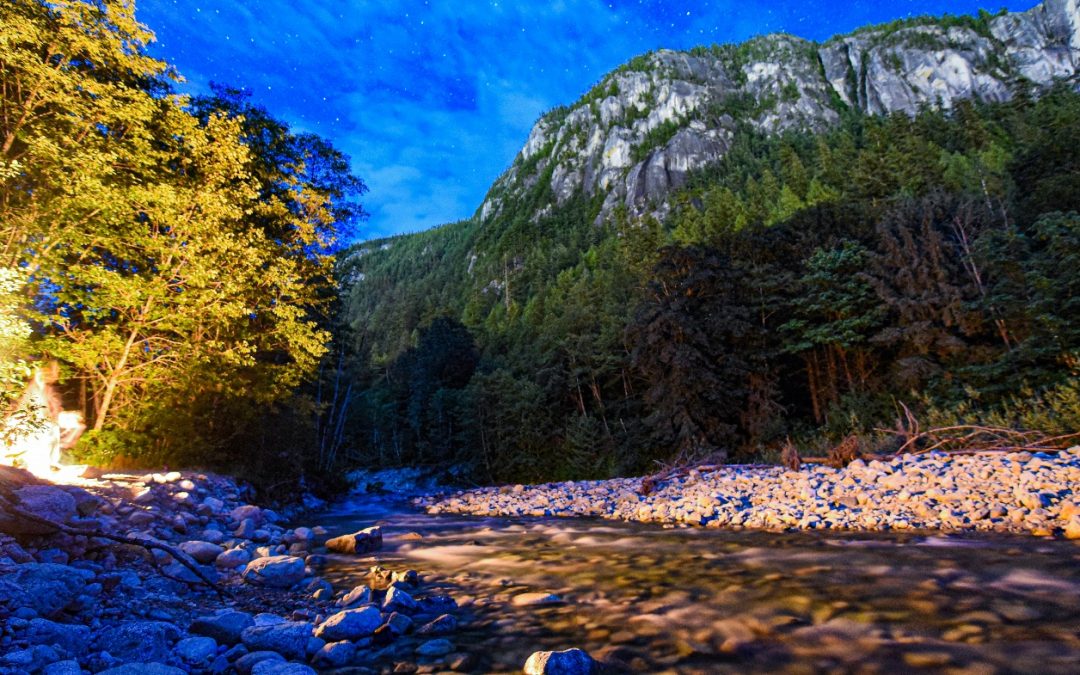
Stawamus River in Valleycliffe, Squamish, British Columbia.
Thank you for taking the time to read our blog! Our first post is a guide to stargazing. This guide will give you insight into safe techniques, best viewing times and recommended equipment for stargazing.
#1) A word about safety.
Stargazing can be dangerous if the risks are not respected and addressed. We always recommend going out with a partner and least leaving an itinerary with a responsible person that includes details about where you are going and when you will be back. You should never stargaze alone in an area that is out
of cell reception.
You should also consider that animals are out. Beware of being in nature especially when alone.
#2) Factors to consider for optimal stargazing.
There are many factors that influence how clearly you can see stars including light pollution, weather, current moon cycle, season, and time of night.
Light pollution means that stargazing is best done away from cities and towns. But if it is your first-time stargazing consider staying closer to town. That way if you make mistakes or leave equipment behind the effects are not as bad.
We recommend checking the forecast early in the day before you make plans to head out. The website we posted below has hourly forecasts which are very insightful when making plans. Cloud cover needs to be avoided to maximize the stars you can see. Smoke and other pollutants are also other factors that should be respected.
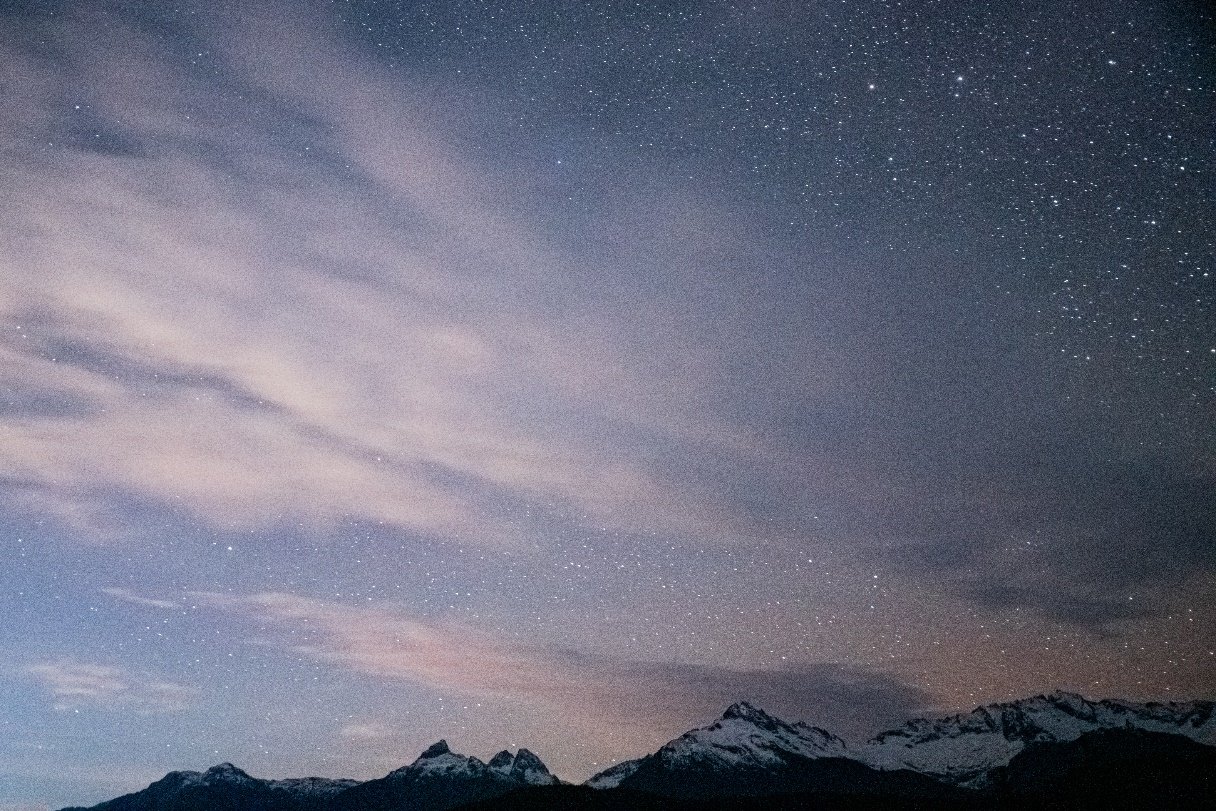
Night with over 50% cloud cover.
Squamish forecast: https://weather.gc.ca/forecast/hourly/bc-50_metric_e.html
Vancouver forecast: https://weather.gc.ca/forecast/hourly/bc-74_metric_e.html
Timing. We recommend stargazing starting approximately 2-3 hours after sunset. During the summer this means that you would be up until approximately midnight and this does not include time to travel back home. However, in the winter with shorter days we can see a good number of stars around 10-11 PM.
Consider the moon phase too. Stargazing is best when the moon is less prominent in the sky. Less than 25% is a good threshold but if you are slightly above this that is okay. When the moon is at 75% or greater its luminosity will overpower stars.
https://www.timeanddate.com/moon/phases/canada/vancouver
Lastly, for more advanced users the Government of Canada has an astronomical planning website with a myriad of tools including sky transparency forecasts.
https://weather.gc.ca/astro/index_e.html
#3) Recommended field gear.
Warm clothes. If you are going out at night especially in wintertime bring a few extra layers, gloves and a toque or face covering.
Headlamp. Will help you move around at night without the need for holding up your phone.
Phone. Communication for emergencies. Can provide maps. Also acts a a backup light (make sure to download a flashlight app!).
Warm liquids are nice after being out in the cold. Bring some tea or coffee to warm up.
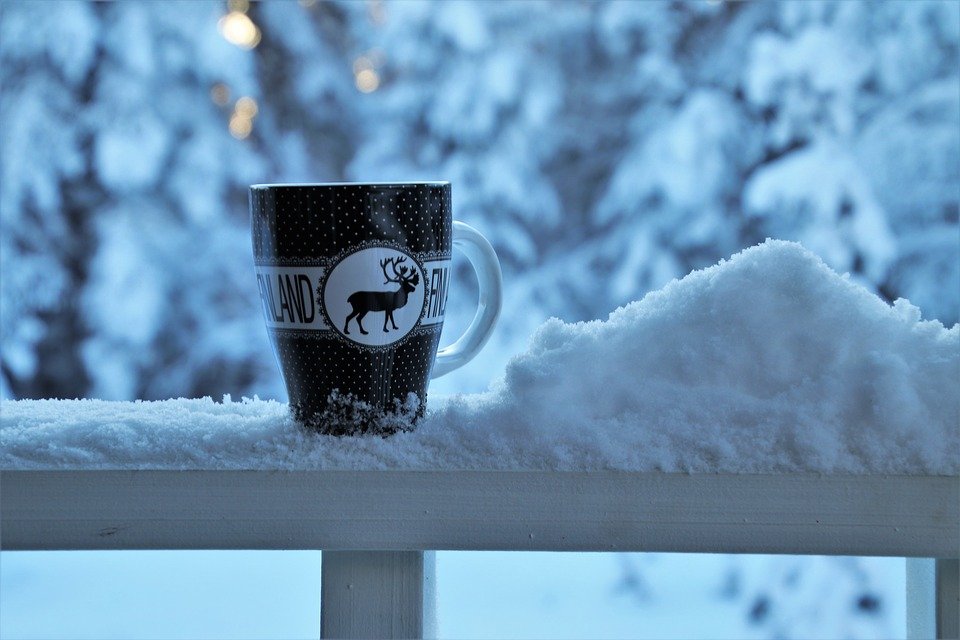
Make sure you have collected all your gear, and that all zippers are closed on your backpacks and other carrying cases. It is very difficult to find lost gear during the dark hours of night. Have a safe trip home!